

New VA study finds access to the GeneSight® test impacted treatment decisions and improved depression remission rates
Study design
The PRIME Care study is the largest pharmacogenomic (PGx) randomized controlled trial (RCT) ever conducted in mental health.
The study investigated whether access to genetic testing results impacted treatment decisions and improved patient outcomes for those with MDD (Major Depressive Disorder).

The study was conducted across 22 VA Clinics with 676 clinicians.

1,944 veteran patients with MDD received the GeneSight Psychotropic test and were randomized to receive results immediately (GeneSight test arm) or after 24 weeks (treatment as usual arm).

The study was funded by the U.S. Department of Veteran Affairs and Myriad Genetics provided the GeneSight tests.
Study results


What is the GeneSight Psychotropic test?
The GeneSight Psychotropic test is a genetic test that shows your healthcare provider how your genes may affect medication outcomes.
The GeneSight test may reveal which medications to treat depression, anxiety, ADHD, and other mental health conditions that:
- Require dose adjustments
- Be less likely to work
- Have an increased risk of side effects based on your DNA
Is the GeneSight test right for you?

Has a mental health medication failed you in the past?
Is your current mental health medication not working?
Does your mental health medication cause unwanted side effects?
We know the process of finding medication that works can be frustrating, time-consuming and debilitating.
Fewer than 50% of individuals with depression respond to their first medication.1
1. Rush AJ, et al. Am J Psychiatry, 2006.
Cost shouldn’t be a barrier to your mental wellness
Our goal is to make the GeneSight test affordable and accessible to patients.

Many insurance plans, including Medicare, often cover the entire or a significant portion of the test.

We offer a financial assistance plan for eligible patients to help with the cost of the GeneSight test.

If your cost is $100 or more, we offer an interest-free payment plan to spread out the cost for up to 12 months.
*Based on a review of six months of past claim data for major insurance carriers across the US. Last updated 2023.


How does it work?
The GeneSight test is administered by your healthcare provider in their office.
Order
The GeneSight test must be ordered by a prescribing clinician who is registered to offer the GeneSight test. This list includes but is not limited to primary care physician, nurse practitioner, physician’s assistant, and/or psychiatrist.
Collection
Your doctor collects a DNA sample by painlessly swabbing the inside of your cheek OR you can collect the sample at home using our patient collection kit.
Lab
The sample is sent to our lab for analysis.
Results
After we receive your sample, your doctor will typically get test results in about 3 days.
Consultation
Your doctor can contact our Medical Affairs team for a consultation. Your doctor can then review the results with you on your next visit.


Start the Conversation About GeneSight
The most important step you can take is to talk to your doctor. If you think genetic testing could be helpful for you or someone you care for, download our GeneSight discussion guide.
A comprehensive report, personalized for you
The GeneSight test report may help you avoid multiple medication trials by providing information about which medications may require dose adjustments, be less likely to work, or have an increased risk of side effects based on your genetic information.
The report also includes information on how a patient’s smoking status may affect their body’s metabolism of certain medications.
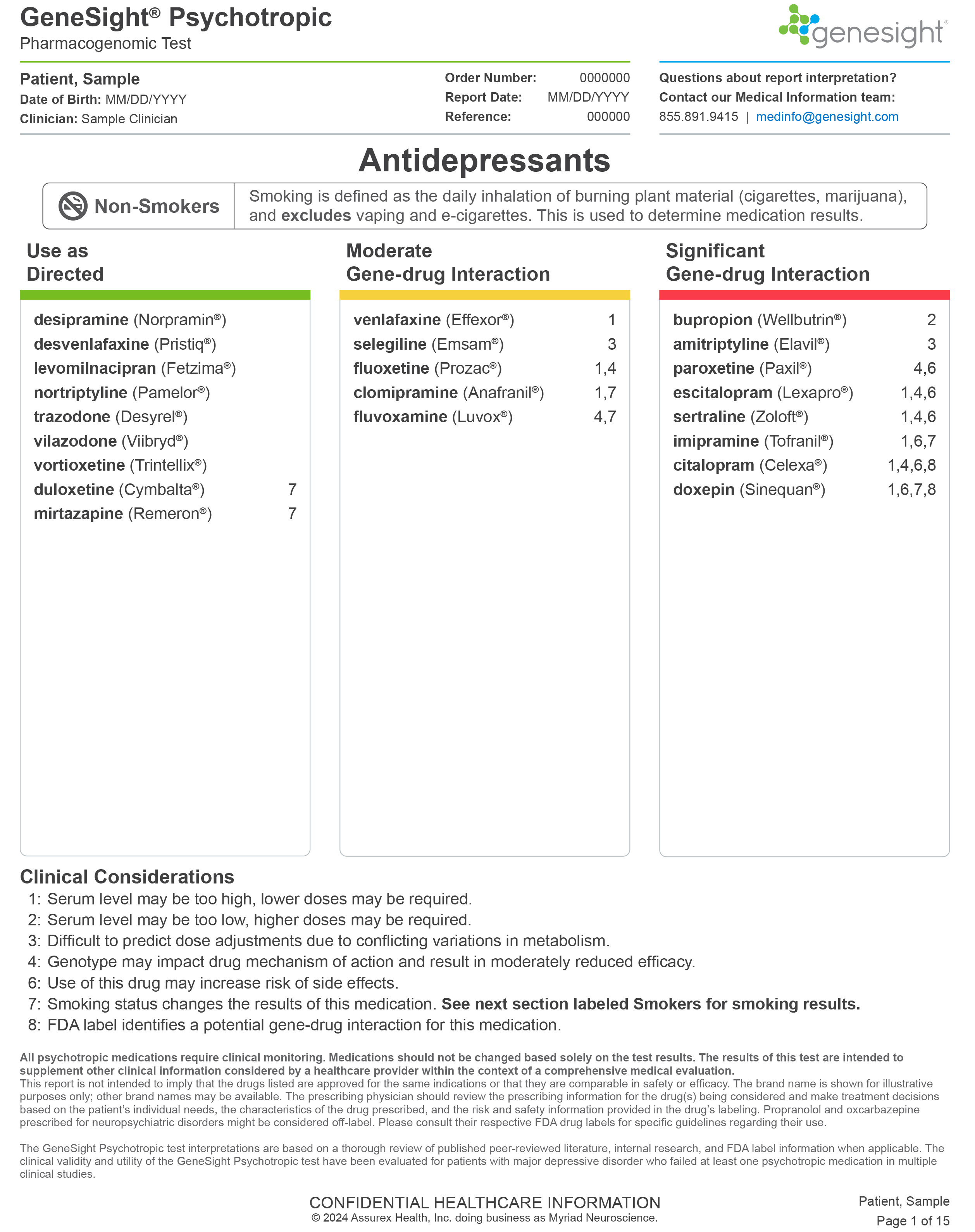
- Use as directed
- Moderate gene-drug interaction
- Significant gene-drug interaction
The report classifies over 60 mental health medications into three categories.
The GeneSight test results do not provide information on disease diagnosis, medication allergies, drug-drug interactions, or which medications will work best.

Your sample is handled with care.
Generally, samples are destroyed within 60 days of receipt, however, the samples may be destroyed at any time after the testing is completed upon request.
The process is a simple cheek swab that will be placed in a paper envelope. This drying process ensures the samples remain stable by preventing microbial growth and breakdown of DNA.
Our lab is located here in the United States, in Mason, OH.



Take the next step with the GeneSight test
Take a step closer to getting the GeneSight test or registering to provide the test to your patients. We will follow up with additional information either via email or phone.
The GeneSight test must be ordered by a registered clinician. If you are a patient, caregiver or office staff who would like a clinician to be registered to administer the GeneSight test, please include their name and contact information.
If you are a current registered provider or tested patient, please contact us.
Take the Next Step - PD
By submitting this form, you authorize Myriad to contact you about your inquiry via email and/or phone (including SMS/text message). Additionally, please note communications may be unsecure and carry typical risks associated with such transmissions. By submitting this form, you also acknowledge that you understand the foregoing warning and understand the typical risk of email and phone transmissions. For further information on our privacy practices, including information about opting-out of communications for Myriad, please visit our Privacy Notice and Notice of Privacy Practices.